It’s easy to tell when students are engaged in your lecture. You know the difference between a class where students are going through the motions and one where they’re invested. The harder question is what actually creates that difference.
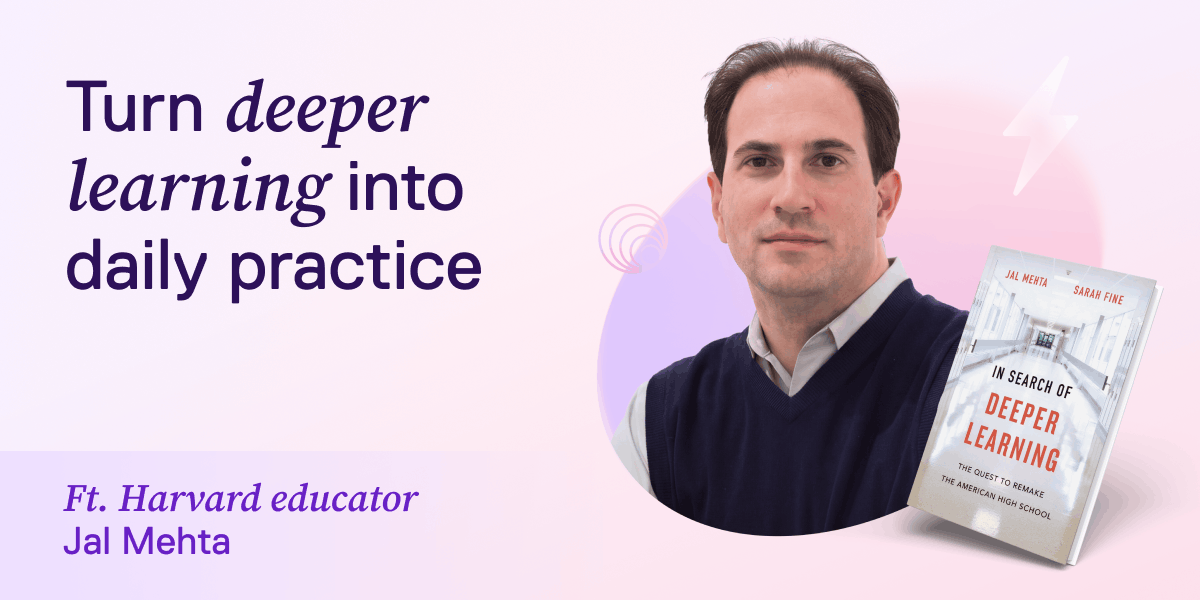
Jal Mehta, professor at the Harvard Graduate School of Education and co-author of In Search of Deeper Learning, spent years visiting classrooms to find out what deeper learning looks like in practice. Mehta recently joined us on our Higher Listenings podcast to share ways instructors can create more engaging spaces in their classroom. Here are seven student engagement strategies you can try, no matter your discipline or class size.
1. Decide four ideas and four skills that must stick
Mehta is candid about how much of a course disappears from memory. “I know this is anathema, but we don’t remember a lot of what we learned in school,” he says. Even his Harvard colleagues, he notes, would fail parts of a test on material they haven’t used in years. His advice is to start with humility: “any semester is just a small taste in a lifelong journey to try to understand a subject.”
For a 13-week course, identify four big ideas and four big skills every student should have grappled with by the end. Once you’ve named them, it’s easier to let go of content that doesn’t serve them.
2. Treat every class as a pitch and open with a question
“Every time you come into a class, you’re essentially making a pitch,” Mehta says. He points to an English teacher who spends most of his planning time on the opening question, because if it doesn’t land, the rest of class is an uphill climb. Mehta agrees: “if that pitch doesn’t carry, then people are simply going through the motions.”
The best classroom engagement strategies start before anyone speaks. Open with a question or exploration, not an agenda slide. Then say why it’s worth wondering about and how it connects to the course’s larger arc.
3. Pause every 15 minutes for a turn-and-talk
Mehta points to research showing people struggle to take in information during prolonged periods. “After 15 or 20 minutes, unless you were a master storyteller, you will have people tuning out,” he says. When you see it happen, stop and pose a question. Have students turn to a neighbor and discuss for a few minutes. Then collect three or four comments from the room.
If that sounds familiar, it’s a close cousin of think-pair-share, one of the simplest active learning strategies there is. You don’t need to hear from everyone. The comments you do hear show you what’s resonating and what isn’t. A live poll or discussion question in Top Hat can do the same job in large lectures.
4. Make class more student-centered: let students do most of the talking
Mehta’s typical class structure is a model of student-centered learning: frame the day’s question briefly, give small groups of three or four an activity, debrief together, then add your own thoughts. Depending on the length of class, repeat the cycle. For more ideas like this, see our guide to active learning.
It also takes less prep than you might expect. “The person who’s doing the talking is doing most of the learning,” Mehta says.
Save your synthesis for after the exploration, either in a follow-up email or at the start of the next class. Written in advance, Mehta says, a wrap-up “feels too cooked.” Written afterward, connecting what students developed to what you know “usually makes it feel more alive.”
5. Teach the “whole game,” not just the parts
Mehta draws on his colleague David Perkins’s idea of the “whole game at the junior level.” His example: “you don’t spend a year throwing and a year catching and a year batting, and then say, when we get to graduate school, you’ll play baseball.” Kids play T-ball, and practice the parts in light of the whole.
He saw the same thing in a school theater production, where everyone knew what they were working toward and each student held a meaningful role. “One year you’re the learner and the next year you’re the teacher.” His diagnosis of most schooling: “schools have a lot of parts and not so many wholes.” Ask yourself where students in your course get to do a small version of the real work of your discipline, instead of just studying it from the sidelines.
6. Help students see themselves as people who do this work
Many students arrive with stories like “I’m not a math person” or “I’m a bad writer.” Mehta argues that “the most powerful thing you can do as a teacher is give someone a new identity:” start students on the path of seeing themselves as someone who does a kind of work.
After visiting summer camps, he came away convinced that “everything is a team sport,” and he’d like classrooms to feel the same way. He describes three levels:
- Build a space where students can be themselves. Frame groups as a shared responsibility to help everyone move forward.
- Look at who is in front of students. If every author on your syllabus looks the same, students will notice. The same goes for guest speakers.
- Model your own curiosity. Come back from a conference and tell students what surprised you.
7. End class with an exit ticket
Not sure where to start? Mehta’s simplest suggestion is an exit ticket. Ask on one side, “what’s one thing you’re taking away from this?” and on the other, “what’s one thing that you don’t understand or are wondering about?” A TA (or a digital form) can sort the responses into piles, and the patterns will tell you what to address next class.
Deeper learning and rigor aren’t opposites
Mehta pushes back on the idea that engagement comes at the expense of rigor. Content versus skills, he says, is a false dichotomy. “You can’t offer an interpretation of the French Revolution without knowing who the Jacobins are, but what use is it to know who the major characters are if you’re not trying to do something with that knowledge?”
Some learning will always be tedious, he concedes. It just needs to be “in service of something that seems purposeful and meaningful.”
Start small. Try one pause, one opening question or one exit ticket this week, and see what your students tell you. Looking for more? Explore our full list of student engagement strategies.