
Bringing Canadian Economics to Life Through Interactive Textbooks
22%
savings on textbook fees per student each term
2,000+
students taught per academic year
12+
years using Top Hat in economics

The Challenge
Unpacking the limits of static, textbooks with localized Canadian-authored content
As an economics instructor at the University of Alberta, Alexander Gainer teaches more than 2,000 first-year students annually across introductory microeconomics and macroeconomics courses. With only a quarter of students pursuing economics as a major, one of his biggest challenges was helping learners see the relevance of economics in their everyday lives. Traditional textbooks often relied on outdated examples and revision cycles that couldn’t keep pace with rapidly changing economic events. And with the slim number of digital textbooks available in the 2010s, Gainer found most offered an experience similar to a static PDF.
Beyond keeping content current, Gainer faced the challenge of ensuring students were learning from materials that reflected Canada’s unique economic landscape. At the University of Alberta, introductory economics courses are required to use textbooks with Canadian content—a policy Gainer sees as essential to deepening student engagement. “If students were learning from U.S.-based materials, it would create additional confusion because our governments, policies and institutions operate differently,” he says. From taxation and government spending to the role of the Bank of Canada, many foundational concepts are applied differently north of the border. Relying on American-focused examples can make course content feel less relevant and create a disconnect between what students read in their textbooks and what they encounter in class or see unfolding in Canadian headlines. “It feels less relevant when students are constantly seeing U.S. policies and news. They really want to understand what’s happening in our current moment in Canada.” It was this desire for real-world, Canadian-specific readings that led him to broaden his use of Top Hat.
School background
The University of Alberta is a leading Canadian research university located in Edmonton, Alberta. Home to more than 45,000 students, it is recognized for academic excellence, innovative teaching and impactful research across a wide range of disciplines.
About the professor
Alexander Gainer is a Teaching Professor in the Department of Economics at the University of Alberta, where he teaches large-enrollment introductory microeconomics and macroeconomics courses online and in person. A long-time innovator in educational technology, Gainer has authored Canadian-focused Top Hat textbooks for Introduction to Microeconomics and Introduction to Macroeconomics that pair clear explanations with interactive learning tools and applied examples from the Canadian economy. His teaching has been recognized with multiple awards, including the University of Alberta’s William Hardy Alexander Award for Excellence in Undergraduate Teaching and the OLC Award for Excellence in Design and Practice.

Alex Gainer Teaching Professor in the Department of Economics at the University of Alberta
The Solution
Combining live data, active learning and AI support
Gainer’s journey with Top Hat began in 2014 when he introduced Top Hat polls into his economics lectures, giving students new opportunities to participate and engage during class. In practice, he used Top Hat to run think-pair-share activities, allowing students to discuss individual answers with a partner to deepen critical thinking skills. For Gainer, fostering active learning in his large theater-style class was made simple with Top Hat’s engagement tools. When approached by Top Hat’s Custom Publishing team in 2017 about authoring his own interactive textbook, the answer was a no-brainer for Gainer. This partnership led to two highly customizable Top Hat textbooks, including Introduction to Microeconomics and Introduction to Macroeconomics, later published in 2022.
Designed specifically for Canadian introductory economics courses, the textbooks combine clear explanations, embedded practice questions, timely Canadian examples and interactive learning tools in one digital resource. The flexibility of Top Hat now allows Gainer to continuously update content with Canadian examples. “It’s so easy to add in Canadian sources in real time. I can pull in case studies from CBC, CTV, and The Globe and Mail, even mid-semester,” he says. Compared to other platforms, Gainer believes Top Hat offers the flexibility he needs as an instructor committed to imparting real-world learning. “Top Hat is so user friendly, robust and less bureaucratic compared to other publishers. Plus, you no longer have to wait for a two-year revision cycle to return before making changes. I can pull in new material every week with ease,” Gainer shares.
“Top Hat is so user friendly, robust and less bureaucratic compared to other publishers. Plus, you no longer have to wait for a two-year revision cycle to return before making changes.”
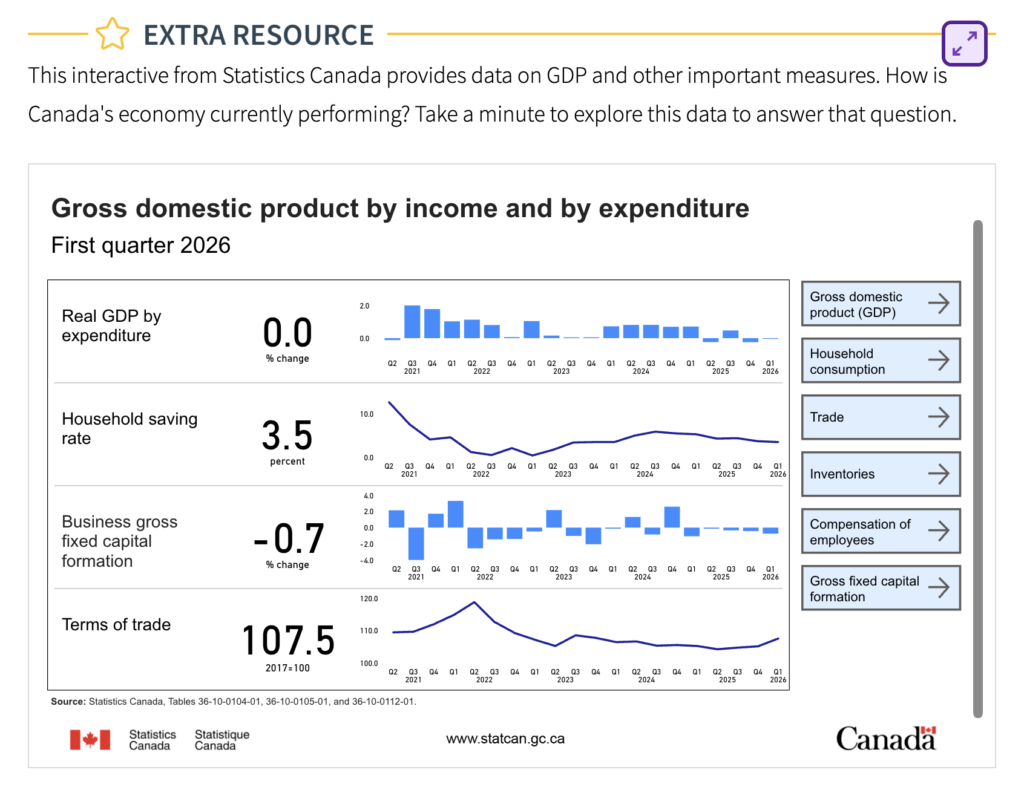
In his macroeconomics textbook, Gainer also embeds live data tables from sources such as Statistics Canada, FRED and Our World in Data. Whether students are analyzing inflation, employment trends or economic growth, they’re working with the latest Canadian data available rather than static charts frozen in time. Gainer also encourages students to use Ace, Top Hat’s AI-powered assistant, to deepen their understanding of course concepts and generate additional practice questions ahead of exams. “The benefit of Ace, compared to Claude and Gemini, is that it pulls directly from my course material and uses the Socratic method. It’s more pedagogically sound and guides students towards answers versus revealing the solution,” he shares. For Gainer, the combination of course-specific study support and pedagogical design makes Ace a valuable extension of the learning experience beyond the classroom.
The Results
Empowering students through relevant, affordable learning experiences
By bringing together current Canadian content, active learning and customized course materials, Gainer has seen a noticeable increase in student engagement. Students participate more actively during lectures through polling and peer discussion activities, while embedded textbook questions encourage them to check their understanding as they read. “Students tell me it’s more rewarding when there are opportunities to engage with the material,” he says. Perhaps most importantly, students report that the course materials feel significantly more relevant, accessible and valuable to their learning experience. University course evaluations show substantial improvement in ratings related to textbook relevance, while students frequently highlight the interactive design of the course materials. As one student shared, “the availability of in-module and in-textbook resources were effective tools for learning the content and helping to apply content in real-world scenarios.” Another noted, “the textbook having practice questions built into the chapters is brilliant and the quizzes are great too.”
Beyond improving engagement, Gainer’s custom Top Hat textbooks have also helped make course materials more affordable. Compared to most economics textbooks, his students now save $66,000 every academic year by using Top Hat. For Gainer, the greatest reward is knowing that students are learning economics through a lens that feels relevant to their lives—one that connects classroom concepts to the Canadian issues, data and decisions shaping the world around them.
Join a community of 750+ campuses that use Top Hat






More Educator Stories
Helping professors make teaching fun and effective
Innovative educators at more than 750 campuses rely on Top Hat. Find out how they use it to engage students and build comprehension before, during and after class.

How a University of Toronto Lecturer is Redefining Cognitive Psychology
This professor turned to Top Hat as a way to bring active experimentation directly into the classroom and bridged the gap between theory and practice

Bringing Canadian Economics to Life Through Interactive Textbooks
By combining current Canadian content, active learning and customized course materials, Professor Alex Gainer has seen a noticeable increase in student engagement.

Reaching a 90% Attendance Rate in a 3,000-Student Psychology Course
Discover how this professor at McMaster University increased student engagement and reached 90% attendance in a 3,000-student psychology course using Top Hat.